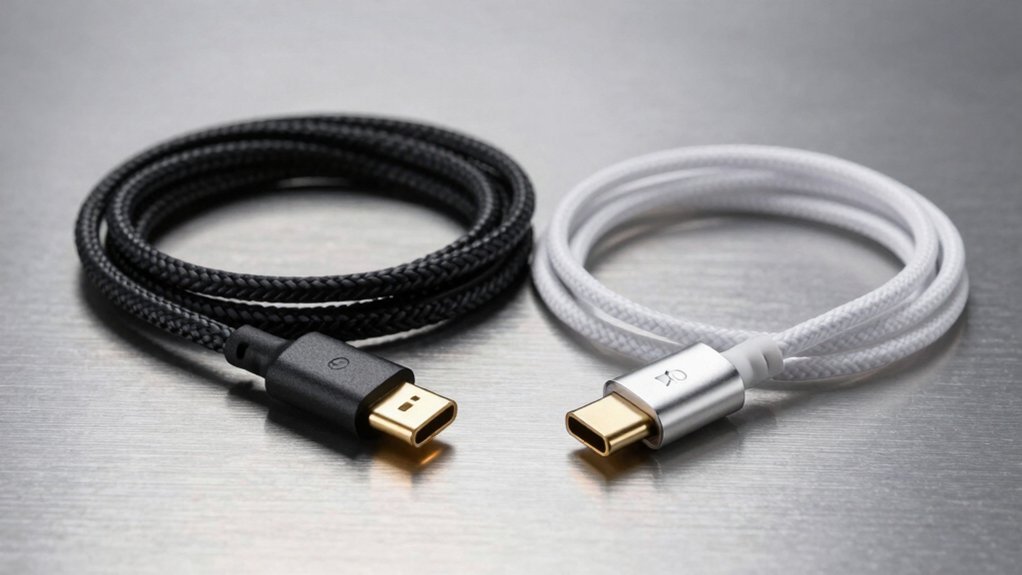
You’re setting up your 2026 studio, and you’ve got a camera tethered to your computer. But what about your phone? It’s become your second monitor, your remote trigger, your creative partner. The cable you choose matters more than you’d think. The right one’ll transform your workflow, while the wrong one leaves you frustrated. Two standouts deserve your attention.
| TetherPro USB-C to USB-C 15′ Cable Orange | Best Long-Distance Setup | Data Transfer Speed: USB-C 5Gbps Gen 1 | Power Delivery: 60W | Cable Length: 15 feet (4.6 meters) | CHECK ON AMAZON | Read Our Analysis | |
| TetherPro 10G USB-C to USB-C 3′ (1m) High-Visibility Orange 60W PD | Best Compact Professional | Data Transfer Speed: 10G USB-C | Power Delivery: 60W PD | Cable Length: 3 feet (1 meter) | CHECK ON AMAZON | Read Our Analysis |
More Details on Our Top Picks
TetherPro USB-C to USB-C 15′ Cable Orange
If you’re managing professional DSLR or mirrorless camera setups in the studio or on location, you’ll find the TetherPro USB-C to USB-C 15′ Cable Orange delivers the reliable performance you need for extended tethering sessions. The cable supports 5Gbps Gen 1 data transfer speeds with consistent conductivity for fast image downloads. Its 15-foot length gives you flexibility in positioning your camera away from your computer. The high-visibility orange sheathing makes locating the cable effortless on busy sets. Nickel-plated tips and gold-plated pins resist corrosion, while full shielding protects against signal interference. You’ll also benefit from 60W power delivery, enabling you to charge devices simultaneously during shoots. The right-angle design routes easily through tight spaces without kinking.
- Data Transfer Speed:USB-C 5Gbps Gen 1
- Power Delivery:60W
- Cable Length:15 feet (4.6 meters)
- Connector Type:USB-C to USB-C
- Shielding & Construction:Fully shielded with nickel plated tips and gold plated pins
- Color:High-Visibility Orange
- Additional Feature:Right-angle design for routing
- Additional Feature:15-foot extended cable length
- Additional Feature:High-visibility orange color
TetherPro 10G USB-C to USB-C 3′ (1m) High-Visibility Orange 60W PD
For studio photographers and filmmakers who demand reliable connectivity without compromising mobility, the TetherPro 10G USB-C to USB-C cable delivers professional-grade performance in a compact 3-foot length. You’ll appreciate the 60W power delivery, which simultaneously charges your device while transferring data at fast speeds. The nickel-plated tips and gold-plated pins ensure consistent conductivity and long-term durability. Its fully shielded construction protects against signal interference, while the high-visibility orange jacket lets you easily locate it in busy studio environments. Built tough for repeated use, this cable’s lightweight design won’t weigh you down during handheld shooting sessions.
- Data Transfer Speed:10G USB-C
- Power Delivery:60W PD
- Cable Length:3 feet (1 meter)
- Connector Type:USB-C to USB-C
- Shielding & Construction:Fully shielded with nickel plated tips and gold plated pins
- Color:High-Visibility Orange
- Additional Feature:10G faster data transfer
- Additional Feature:Compact 3-foot form factor
- Additional Feature:Gold plated pins construction
Factors to Consider When Choosing Phone Photography Tethering Cables for Studio Control
When you’re selecting a tethering cable for studio phone photography, you’ll want to evaluate how cable length affects your setup’s flexibility and whether the data transfer speed meets your real-time monitoring needs. You should also verify that the cable supports adequate power delivery for your device and check that both connectors match your phone and computer ports. Finally, you’ll need to assess the cable’s durability and build quality, since studio environments demand reliable equipment that’ll withstand frequent use and repositioning.
Cable Length And Reach
How far should your tethering cable stretch in your studio? Cable length directly impacts your setup’s flexibility and functionality. You’ll find two primary options suited for different workflows: a 3-foot variant works perfectly for compact studio desks where your camera and computer stay in close proximity. Alternatively, a 15-foot cable gives you ample reach for on-location tethering and larger, cluttered setups that demand greater distance between your equipment.
When selecting your cable length, you’ll need to guarantee it supports 60W power delivery across your chosen distance without performance degradation. A longer cable doesn’t automatically mean better results—consider your actual working space and shooting style to avoid unnecessary bulk while maintaining reliable connectivity and power standards.
Data Transfer Speed Requirements
Your tethering cable’s data transfer speed directly affects how quickly images move from your phone to your computer during studio sessions. USB-C Gen 1 cables max out at 5Gbps (roughly 625 MB/s theoretically), while 10G cables deliver up to 10Gbps (approximately 1,250 MB/s). You’ll find real-world speeds lower than advertised due to protocol overhead and device compatibility issues.
For typical studio work, a 5Gbps cable handles standard compressed photos adequately. However, if you’re shooting high-volume uncompressed RAW frames or high-frame-rate video, you’ll benefit from a 10G cable’s extra headroom. Match your cable speed to your camera-to-computer data path to prevent bottlenecks that slow your workflow and compromise live preview responsiveness.
Power Delivery Capabilities
Beyond data speed, power-delivery support fundamentally changes how you’ll operate in the studio. Many modern tethering cables support 60W Power Delivery, enabling you to charge your phone or camera while maintaining the tether connection. This capability eliminates the need for separate power cables, reducing clutter and simplifying your setup.
The 60W PD standard guarantees safe voltage and current negotiation between your devices through USB-C protocols. You’ll maintain stable camera operation even over longer tether lengths without performance degradation. Before purchasing, verify PD compatibility between your specific phone model and computer to guarantee the negotiated power level remains consistent throughout your shoot.
This single-cable solution streamlines your studio workflow considerably.
Durability For Studio Environments
While power delivery keeps your devices charged during extended shoots, the cable itself must withstand the physical demands of studio work. You’ll benefit from fully shielded and plated construction that resists interference and endures repeated plugging and unplugging. Nickel-plated tips with gold-plated pins enhance connection longevity against frequent use during long shoots, while a sturdy inner layer protects against wear from bending, coiling, and device movement. Right-angle plug designs reduce strain and snag risk, improving durability when routing cables around lights, tripods, and monitors. High-visibility orange coloring aids in quick recovery and reduces accidental tugs, supporting overall durability in cluttered studio spaces. These features combine to keep your tethering setup reliable throughout demanding production schedules.
Connector Type Compatibility
How do you guarantee that your phone, camera, and computer can actually communicate through your tethering cable? You’ll need to verify that all three devices support USB-C to USB-C connections before purchasing any cable. Don’t assume compatibility—check your phone’s charging port, your camera’s data connection, and your computer’s available ports.
Beyond basic USB-C compatibility, you’ll want to match the cable’s data rate to your workflow. Standard 5 Gbps Gen 1 cables handle typical tethering tasks efficiently, but if you’re transferring large RAW files frequently, you’ll benefit from 10 Gbps options.
Consider your studio’s physical layout too. Straight connectors work for most setups, but right-angle connectors provide better cable management when space is tight or when you need cables routed along studio edges without stress on your devices.
Signal Shielding And Interference Protection
Once you’ve confirmed your devices work together, you’ll want to protect the signals traveling through your cable. Fully shielded and plated construction safeguards your data from external interference during studio tethering sessions. The shielding reduces radio frequency and EMI noise, which directly improves data integrity when you’re transferring high-speed files between your phone and computer.
Nickel-plated tips and gold pins enhance contact quality at connector interfaces, minimizing signal degradation that could compromise your workflow. An inner protective layer maintains shielding effectiveness through repeated use, guarantee your cable performs consistently over time. If you’re working in variable studio environments, consider cables with high-visibility jackets that preserve shielding performance while improving visibility. These features collectively guarantee reliable signal transmission without compromising protection.
Frequently Asked Questions
How Do Tethering Cables Improve Studio Workflow Compared to Wireless Connectivity Options?
You’ll experience zero latency delays when you’re tethering, ensuring instant image transfer to your monitor. You’re also guaranteed stable connections without dropouts, giving you reliable control throughout your studio sessions without wireless interference issues.
What Are the Main Compatibility Issues Between Older Phones and Modern Tethering Cables?
You’ll encounter connector mismatches, as older phones use micro-USB while newer models feature USB-C. You’re also limited by outdated software incompatibility and insufficient power delivery. Legacy devices won’t support modern tethering protocols either.
Can Tethering Cables Damage Phone Charging Ports With Prolonged Studio Use?
Yes, you can damage your phone’s charging port with prolonged studio use. You’ll want to rotate between multiple cables, use quality connectors, and avoid excessive tension. You’re preventing wear by taking these precautions seriously.
Are There Differences in Image Transfer Speeds Between USB-C and Lightning Cables?
You’ll find USB-C cables typically offer faster transfer speeds than Lightning cables. USB-C supports higher bandwidth standards, enabling quicker image transfers during studio sessions. Lightning’s speed capabilities depend on your device’s generation and specifications.
How Should Tethering Cables Be Stored and Maintained for Long-Term Durability?
You’ll extend your cable’s life by storing it loosely coiled in a cool, dry place away from direct sunlight. You should avoid sharp bends, keep connectors clean, and periodically inspect for damage.