
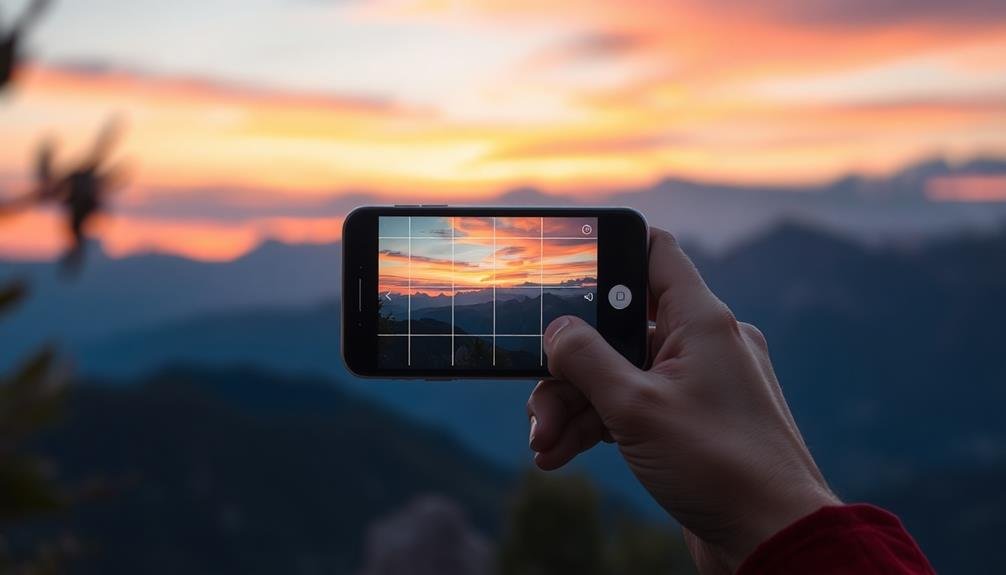
To achieve balanced mobile photo compositions, start by applying the Rule of Thirds. Enable your phone's grid feature and place key elements along the lines or intersections. Next, look for symmetry and patterns to create visually striking images. Utilize leading lines like roads or fences to guide the viewer's eye to your main subject. Try framing your subject within natural elements like archways or branches for added depth. Finally, embrace negative space by positioning your subject off-center against a clean background. These techniques will help you create more dynamic and engaging smartphone photos. Discover how these principles can transform your mobile photography skills.
Rule of Thirds
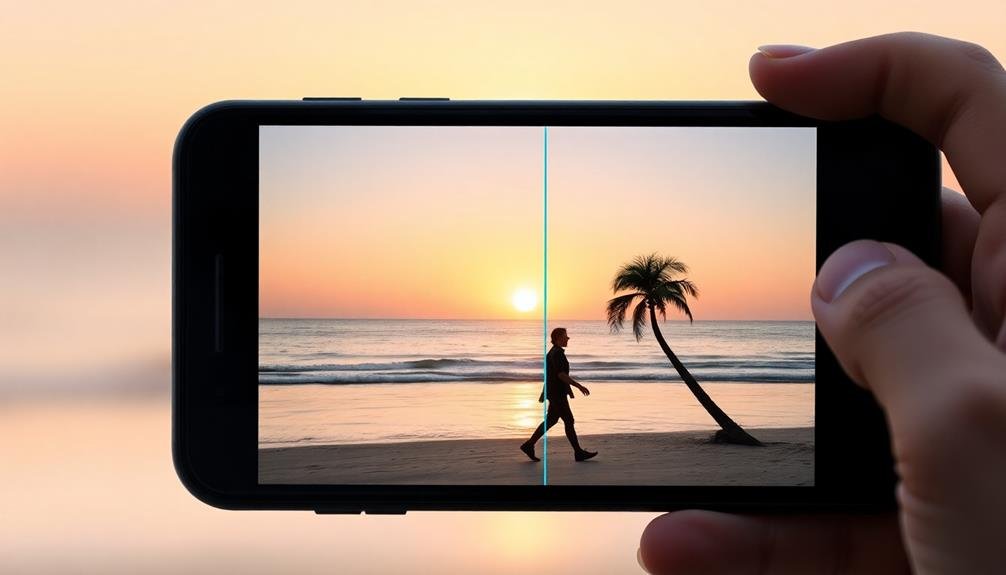
The Rule of Thirds is one of the most fundamental principles in mobile photography composition. It's a simple yet powerful technique that can dramatically improve your mobile photos.
To apply this rule, imagine your phone's screen divided into a 3×3 grid. The key is to place your main subject along these lines or at their intersections, rather than centering it.
When you're framing your shot, position important elements along these gridlines. For landscapes, try aligning the horizon with the top or bottom horizontal line. For portraits, place your subject's eyes near the upper intersections. This creates a more balanced and visually appealing image that naturally draws the viewer's eye to the focal points.
Most smartphones have a built-in grid feature you can enable in your camera settings. Use this tool to help you compose your shots until the Rule of Thirds becomes second nature.
Symmetry and Patterns

While the Rule of Thirds emphasizes asymmetry, symmetry and patterns can create equally compelling mobile photos. You'll find symmetry in architecture, reflections, and natural elements. To capture symmetrical compositions, position your subject in the center of the frame. Use your phone's grid feature to align elements precisely.
Patterns, on the other hand, are repetitive elements that create visual rhythm. They're often found in textures, architectural details, and natural formations. When shooting patterns, fill the frame to create impact. Experiment with different angles to reveal unique perspectives.
Here's a quick guide to symmetry and pattern types:
| Type | Symmetry | Pattern |
|---|---|---|
| Reflective | Mirror-like | Repeated shapes |
| Radial | Circular | Spiral |
| Translational | Shifted | Linear |
| Rotational | Turned | Circular |
| Fractal | Self-similar | Recursive |
To break the monotony of symmetry or patterns, introduce a contrasting element. This creates a focal point and adds interest to your composition. Remember, you can combine symmetry and patterns with other composition techniques for more dynamic mobile photos.
Leading Lines

Moving from symmetry and patterns, we encounter another powerful composition technique: leading lines. These are elements within your frame that guide the viewer's eye toward a specific point of interest. They can be straight, curved, or even implied, and they're incredibly effective in mobile photography. You'll find leading lines everywhere in both urban and natural environments.
To use leading lines effectively in your mobile photos:
- Identify natural lines in your surroundings (roads, fences, rivers)
- Position your camera to emphasize these lines
- Use the lines to draw attention to your main subject
- Experiment with different angles to create unique perspectives
When composing your shot, consider how the lines interact with your subject. They should complement, not overpower, the focal point.
You can use converging lines to create a sense of depth, or parallel lines to convey stability. Don't forget about vertical lines, which can add height and drama to your images.
With practice, you'll develop an eye for spotting and utilizing leading lines, resulting in more dynamic and engaging mobile photographs that naturally draw the viewer's gaze where you want it to go.
Framing Within the Frame

Framing within the frame is a compositional technique that adds depth and focus to your mobile photos. It involves using elements within the scene to create a natural border around your main subject. This technique draws the viewer's eye to the focal point and creates a sense of context.
Look for natural frames in your environment, such as archways, windows, tree branches, or doorways. Position your subject within these frames to create a visually appealing composition. You can also use man-made structures like bridges or fences to achieve this effect.
When framing your subject, make sure that the frame doesn't overpower the main element. Adjust your position or zoom to find the right balance. Experiment with different angles to create unique perspectives. Sometimes, partially obscuring the frame can add intrigue to your image.
Consider the relationship between the frame and your subject. The frame should complement and enhance the main focus, not detract from it. Pay attention to lighting as well; frames can create interesting shadows or highlight your subject.
Remember that framing doesn't always have to be literal. You can use color, contrast, or negative space to create a virtual frame within your mobile photo.
Negative Space

Negative space is a powerful compositional tool that complements framing techniques in mobile photography. It's the area surrounding your main subject, often overlooked but essential for creating balance and emphasis.
By incorporating negative space, you'll draw attention to your subject and create a sense of simplicity and elegance in your mobile photos.
To effectively use negative space in your compositions:
- Look for clean backgrounds: Seek out plain walls, clear skies, or uncluttered surfaces to serve as negative space.
- Position your subject off-center: This creates an imbalance that draws the viewer's eye and adds visual interest.
- Experiment with minimalism: Try capturing a small subject within a large expanse of negative space for dramatic effect.
- Use negative space to convey emotion: A lot of empty space can create feelings of isolation, peace, or contemplation.
Frequently Asked Questions
How Can I Stabilize My Smartphone for Clearer Mobile Photos?
You can stabilize your smartphone for clearer photos by using a tripod or selfie stick. If you don't have those, try bracing your elbows against your body, holding your breath, or leaning against a stable surface while shooting.
What Apps Are Best for Editing Mobile Photos After Composition?
You'll find several great apps for editing mobile photos. Try Snapseed, VSCO, or Lightroom Mobile for powerful tools. Adobe's Photoshop Express offers quick fixes, while Afterlight provides creative filters. Choose based on your editing needs and skill level.
How Do I Adjust Exposure and Focus on My Smartphone Camera?
You can adjust exposure by tapping the screen and sliding up or down. For focus, tap where you want to focus. Most smartphones allow you to lock these settings by long-pressing the desired area.
Should I Use the Smartphone's Built-In Camera or a Third-Party App?
You'll often get great results with your smartphone's built-in camera app. However, third-party apps can offer more advanced features and control. Try both to see which suits your needs and photography style best.
How Can I Capture Moving Subjects Effectively in Mobile Photography?
To capture moving subjects effectively, you'll want to use your phone's burst mode or a fast shutter speed. Pan with the subject's movement, focus on their predicted position, and try pre-focusing to reduce lag time.
In Summary
You've now got five powerful tools for creating eye-catching mobile photos. Remember, the rule of thirds adds balance, symmetry creates order, leading lines guide the eye, framing adds depth, and negative space lets your subject breathe. Don't be afraid to experiment with these techniques and break the rules when it feels right. With practice, you'll develop an intuitive sense for composition that'll elevate your mobile photography. Keep shooting, stay creative, and watch your skills grow!




Leave a Reply