You’re managing lighting conditions across your studio, garden, or workplace, yet you’re uncertain which light meter app will truly serve your needs. Bluetooth connectivity, sensor accuracy, and data logging capabilities vary considerably among 2026’s top options. The right pairing can transform how you monitor lux levels—but choosing wrong means wasted investment. Let’s examine which apps deliver real results.
| Bluetooth Lux Meter Light Meter for Plants & Photography |  | Best For Data Logging | Measurement Range: 0.1–200,000 Lux (0.01–20,000 FC) | Bluetooth Connectivity: Yes, with app data logging | Sensor Design: Silicon photodiode, fixed 120° angle | CHECK ON AMAZON | Read Our Analysis |
| HoldPeak Illuminance Light Meter with Bluetooth |  | Most Versatile Sensor | Measurement Range: 1–400,000 Lux | Bluetooth Connectivity: Yes, mobile app remote monitoring | Sensor Design: Silicon filter photodiode, 270° rotating | CHECK ON AMAZON | Read Our Analysis |
| MT-92H Light Meter Lux/Foot Candles Temperature Measurer | 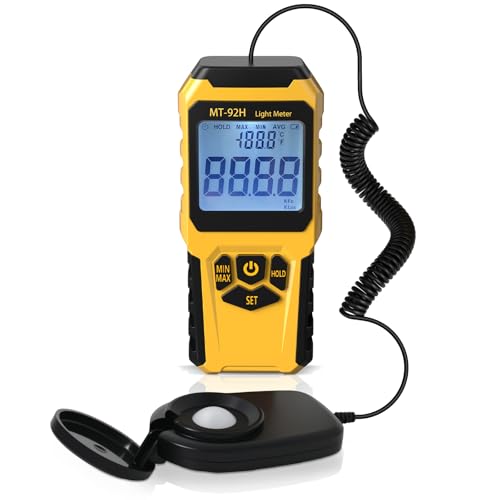 | Best Accuracy | Measurement Range: 0–200,000 Lux | Bluetooth Connectivity: No | Sensor Design: Split-sensor technology with separate probe | CHECK ON AMAZON | Read Our Analysis |
| YW-552 Digital Light Meter for Plants & Photography |  | Best For Plants | Measurement Range: 0–200,000 Lux (0–20,000 Fc) | Bluetooth Connectivity: No | Sensor Design: Split sensor design with high-sensitivity probe | CHECK ON AMAZON | Read Our Analysis |
| Light Meter Digital Illuminance Meter with Bluetooth Data Logging |  | Professional Grade Pick | Measurement Range: 0–200,000 Lux | Bluetooth Connectivity: Yes, 32,752 groups data logging | Sensor Design: Split-type corded sensor | CHECK ON AMAZON | Read Our Analysis |
More Details on Our Top Picks
Bluetooth Lux Meter Light Meter for Plants & Photography
If you’re managing light conditions across multiple environments—whether you’re optimizing plant growth, perfecting photography setups, or monitoring industrial spaces—this Bluetooth lux meter delivers real-time data logging and remote analysis through its companion app. You’ll measure light intensity from 0.1 to 200,000 lux with ±4% accuracy using its high-performance silicon photodiode sensor. The device records up to 2,000 data groups offline, letting you track measurements without constant connectivity. Its 4-digit backlit display shows real-time readings, MAX/MIN values, and switchable lux or footcandle units. Powered by two AAA batteries, it samples twice per second across the 400–700 nm spectrum with a 120° incident angle, ensuring precise readings in warehouses, factories, hospitals, and agricultural settings.
- Measurement Range:0.1–200,000 Lux (0.01–20,000 FC)
- Bluetooth Connectivity:Yes, with app data logging
- Sensor Design:Silicon photodiode, fixed 120° angle
- Display Units:Lux/FC switchable, 4-digit backlit display
- Data Modes:MAX/MIN display, data hold
- Power Source:2 AAA batteries
- Additional Feature:Offline data recording (2000 groups)
- Additional Feature:120° incident angle sensor
- Additional Feature:Auto power-off with disable option
HoldPeak Illuminance Light Meter with Bluetooth
The HoldPeak Illuminance Light Meter with Bluetooth stands out for professionals and enthusiasts who need remote monitoring and precise light measurements across diverse environments. You’ll appreciate its 1–400,000 LUX range with 0.1 lux resolution, powered by silicon filter diodes for high accuracy. The 270° rotating sensor lets you capture ideal measurement angles effortlessly. Its Bluetooth connectivity enables real-time mobile app monitoring and data storage, while the enlarged LCD display shows LUX/FC conversions and ambient temperature. Whether you’re evaluating LED grow lights for plants, photography setups, or industrial lighting in factories and stages, this versatile meter handles fluorescent, metal halide, and high-pressure sodium sources reliably.
- Measurement Range:1–400,000 Lux
- Bluetooth Connectivity:Yes, mobile app remote monitoring
- Sensor Design:Silicon filter photodiode, 270° rotating
- Display Units:Lux/FC conversion, enlarged LCD display
- Data Modes:Data storage and remote recording
- Power Source:Not specified
- Additional Feature:270° rotating sensor head
- Additional Feature:Ambient temperature measurement
- Additional Feature:Ultra-wide measurement range (400,000 Lux)
MT-92H Light Meter Lux/Foot Candles Temperature Measurer
Professional photographers and lighting designers who need simultaneous light measurement and temperature monitoring will find the MT-92H’s split-sensor technology invaluable. You’ll measure light across 0–200,000 Lux with ±3% accuracy and 0.1 Lux resolution, while the separate probe maintains measurement integrity from any angle. The high-visibility backlit display remains readable in darkness or direct sunlight, and you’ll toggle between Lux/Foot Candles and ℃/℉ with a single button. At just 188g with compact dimensions, this durable device fits professional environments seamlessly. Its 0.5-second refresh rate keeps you updated in real-time, powered by standard 3×AAA batteries for reliable fieldwork performance.
- Measurement Range:0–200,000 Lux
- Bluetooth Connectivity:No
- Sensor Design:Split-sensor technology with separate probe
- Display Units:Lux/Fc dual units, backlit display
- Data Modes:Not specified
- Power Source:3 AAA batteries
- Additional Feature:Split-sensor probe design
- Additional Feature:Ultra-bright glare-resistant display
- Additional Feature:0.5 second refresh rate
YW-552 Digital Light Meter for Plants & Photography
For plant enthusiasts and photography hobbyists who need reliable light measurements without professional-grade complexity, you’ll find the YW-552 Digital Light Meter an excellent fit. This device captures illuminance readings up to 200,000 Lux with ±3% accuracy, taking two measurements per second. Its split sensor design lets you measure light from any direction, making it ideal for evaluating plant growth conditions or photography setups. You’ll appreciate the switchable display units (Lux/Fc, °C/°F), Max/Min modes, and data hold function. With storage for 60 readings and a backlit screen, you’ll monitor lighting conditions effortlessly in any environment.
- Measurement Range:0–200,000 Lux (0–20,000 Fc)
- Bluetooth Connectivity:No
- Sensor Design:Split sensor design with high-sensitivity probe
- Display Units:Lux/Fc switchable, backlit screen
- Data Modes:Max/Min/Average, data hold, beep alert
- Power Source:Not specified
- Additional Feature:Up to 60 readings storage
- Additional Feature:Beep alert function
- Additional Feature:2 readings per second
Light Meter Digital Illuminance Meter with Bluetooth Data Logging
Bluetooth connectivity and unlimited cloud storage make this illuminance meter ideal if you’re managing multiple lighting projects simultaneously or need extensive data records without device constraints. You’ll appreciate the split-type corded sensor that lets you position it precisely in bright beams. With four measurement ranges spanning 0–200,000 Lux, you’re covered for any lighting scenario. The device records up to 32,752 data groups at intervals from 1–9,999 seconds, while the iPhone app enables seamless data transfer and analysis. Features like MAX/MIN/AVG tracking, Data Hold, and ambient temperature measurement enhance your precision work. Though Android compatibility’s absent, this Landtek meter’s compact design and large LCD display make it perfect for plant optimization and photography applications.
- Measurement Range:0–200,000 Lux
- Bluetooth Connectivity:Yes, 32,752 groups data logging
- Sensor Design:Split-type corded sensor
- Display Units:Lux/Fc switchable, large LCD display
- Data Modes:Max/Min/Average, data hold, alarms
- Power Source:Not specified
- Additional Feature:32,752 group data logging
- Additional Feature:Corded split-type sensor
- Additional Feature:iPhone/PC app compatibility
Factors to Consider When Choosing Light Meter Apps Paired With Sensor Accessories
When you’re selecting a light meter app with sensor accessories, you’ll want to evaluate your Bluetooth connectivity needs, the measurement range and accuracy that suits your work, and whether the sensor design offers the flexibility you require. You should also consider how much data you’ll need to store and whether the app’s display quality meets your readability standards in various lighting conditions. These factors work together to determine whether a system’ll genuinely serve your photography, videography, or lighting design needs.
Bluetooth Connectivity and Range
How critical is wireless connectivity to your light metering workflow? Bluetooth connectivity transforms how you capture and manage illuminance data. You’ll appreciate real-time recording and remote monitoring through companion apps, eliminating manual note-taking during shoots. Most devices store up to 2,000 offline data groups, ensuring you won’t lose measurements when disconnected.
The ability to export and analyze data later proves invaluable for trend analysis and documentation. You can review past measurements directly through app history without accessing your device physically. However, verify platform compatibility—some systems prioritize iPhone/iOS support while limiting Android functionality. Strong Bluetooth range matters too, especially for larger locations. Synchronizing readings with your mobile device creates a seamless workflow that supports both immediate feedback and long-term project tracking.
Data Storage Capacity Requirements
Data storage capacity directly impacts how long you can record measurements before syncing to your mobile device. You’ll want devices specifying concrete offline logging capacity—look for models offering up to 2000 data groups or higher. Some Bluetooth-enabled sensors provide 32,752 groups, considerably extending recording intervals between transfers.
Check whether your chosen app supports cloud syncing or long-term storage, which eliminates hardware constraints entirely. Verify the data grouping unit, such as Lux readings with timestamps, and confirm the app exports data for external analysis.
Consider your project’s retention requirements. You’ll need to assess whether the device’s max/min/avg features and auto-delete settings align with your data preservation needs, ensuring you don’t lose critical measurements.
Measurement Range and Accuracy
Once you’ve confirmed your device can store sufficient readings, you’ll need to evaluate whether its measurement range and accuracy specifications match your application requirements. Most meters cover 0.1 to 200,000 Lux, accommodating everything from dim indoor spaces to bright outdoor environments. You’ll find accuracy typically ranges from ±3% to ±4% across the full spectrum, though this varies by model. High-resolution options offering 0.1 Lux increments help you capture precise readings within that broad range. Consider whether your app reports dual units—Lux and Fc—since accuracy specifications may differ between them. Features like auto-ranging, DATA HOLD, and MAX/MIN tracking influence how reliably momentary measurements reflect true illuminance, so verify these align with your specific needs.
Sensor Design and Flexibility
The physical design of your light meter’s sensor fundamentally shapes where and how you can take measurements. Split-sensor designs with separate probes let you measure from unobstructed angles and position equipment flexibly. A rotating sensor—offering 270° on one side or 90° on the other—enables ideal alignment to your light source without repositioning the entire device.
High-sensitivity probes and split-type configurations improve measurement integrity when sensors must stay away from targets. Multi-directional sensing supports any-direction measurement, making your meter versatile for plants, photography, and ambient lighting assessments. A 120° incident angle provides a wide field of view, capturing pervasive lighting conditions effectively.
These design features determine whether you’ll capture accurate readings in tight spaces or unconventional setups.
Display Quality and Readability
Your meter’s display is only useful if you can actually read it when you need to. You’ll want a backlit or illuminated 4-digit screen that performs well in low-light environments where you’re taking measurements. Conversely, if you’re working in bright outdoor or stage lighting, you’ll benefit from high-visibility, ultra-bright displays with glare-resistant technology that maintains legibility.
Enlarged LCD screens with clear digit presentation let you quickly interpret Lux and FC values during live measurements without squinting. Look for displays showing multiple readouts simultaneously—Lux/FC, MAX/MIN, and data hold functions—so you’ll access relevant information at a glance. Some meters display ambient temperature alongside illuminance readings, giving you contextual data without switching views.
Operating System Compatibility
Beyond guaranteeing you can read your meter’s display clearly, you’ll need to confirm that the companion app actually runs on your devices. Some meters offer iOS-only Bluetooth compatibility, leaving Android users without support or with limited functionality. You should verify whether your smartphone’s operating system—iOS, Android, or both—receives full feature access, including data logging, cloud syncing, and export capabilities.
If you’re using a desktop workflow, check that PC or Mac apps support your computer’s OS version and receive regular updates. Compatibility directly impacts your data management process, so confirm the app covers all required features on your specific platform before purchasing. This guarantees seamless integration between your sensor accessory and your preferred devices.
Battery Life and Power Options
How long can your light meter run before draining its batteries? Most meters rely on replaceable AAA batteries—typically two or three depending on the model. You’ll want to weigh several power factors when selecting your accessory.
Bluetooth and data logging capabilities substantially drain batteries due to wireless transmission and active storage. Similarly, higher sampling rates and frequent display updates consume more power. If you need continuous, uninterrupted monitoring, choose a model allowing you to disable auto power-off features. This flexibility lets you maintain operation during critical shoots.
Pair your selected meter with fresh, high-capacity batteries for maximum runtime. Understanding these power dynamics guarantees your light meter stays operational when you need it most.
Application-Specific Use Cases
Different professional environments demand distinct light measurement capabilities, so selecting the right app-sensor combination depends on your specific workflow. If you’re growing plants, you’ll want sensors logging data across 0.1–200,000 Lux to evaluate photosynthesis adequacy. Photographers and lighting technicians benefit from real-time readings, unit switching between Lux and Foot-candles, and MAX/MIN storage. Industrial settings require high-accuracy sensors (±3–±4%) with Bluetooth logging and threshold alerts for compliance. Classroom applications need rotating sensors that measure diverse light sources like LED and fluorescent while recording temperature. Facility managers leverage auto-range capabilities and extensive data storage to compare performance across multiple zones. Your choice hinges on measurement precision, connectivity features, and long-term logging needs.
Frequently Asked Questions
Can Light Meter Apps Work Without Purchasing Additional Sensor Accessories?
You can use light meter apps without purchasing sensor accessories. Your phone’s built-in camera sensor provides basic light metering capabilities. However, you’ll get more accurate, professional-grade measurements when you add external sensors to your setup.
What Is the Average Lifespan of Light Meter Sensor Accessories Before Replacement?
You’ll typically get 3-5 years of reliable performance from your light meter sensor accessories before you’ll need to replace them. However, you can extend their lifespan by protecting them from moisture and extreme temperatures.
Are Light Meter Apps Compatible With Both iOS and Android Devices?
You’ll find that most light meter apps work on both iOS and Android devices. However, you should verify compatibility before downloading, as some specialized apps may favor one platform over the other depending on their sensor requirements.
How Accurate Are Smartphone Light Meters Compared to Professional-Grade Equipment?
You’ll find smartphone light meters aren’t as accurate as professional equipment, typically varying by 1-2 stops. They’re useful for casual photography, but you’d want dedicated meters for critical studio work requiring precision.
Do Light Meter Apps Require Internet Connectivity to Function Properly?
You don’t need internet connectivity for most light meter apps to function. Once you’ve downloaded them, they’ll work offline using your device’s built-in light sensor. You’ll only need connectivity for updates or cloud storage features.

Leave a Reply